 how-to
7 Ways to Style Quirky Home Decor Without Clutter
Last Updated: November 7, 2026
Quick Summary
The fastest way to style quirky home decor without clutter is to build the room around a single anchor piece, then keep everything else calm and supportive. Pick one bold object you genuinely love, place it where it gets seen, and edit out anything that competes with it.
- Choose one loud statement piece, then keep the rest of the room calm.
- Limit the palette to two base colors, one accent, and one wildcard color.
- Style a living room in four passes: anchor, seating, textiles, then accessories.
- Split your decor budget with about half going to the anchor piece.
- Rotate accessories instead of displaying everything at once to avoid clutter.
Table of Contents
- Start With One Focal Point for Your Quirky Home Decor
- How to Mix Vintage and Modern Decor Without Mismatches
- Building a Modern Whimsical Home Decor Palette That Holds Together
- Whimsical Decor Living Room: A Room-by-Room Styling Process
- Sourcing Quirky Decor Items on a Budget and in Small Spaces
- Pick Your Anchor Piece and Build the Room Around It
- Frequently Asked Questions
Start With One Focal Point for Your Quirky Home Decor
The fastest way to style quirky home decor without clutter is to build the room around a single anchor piece. One bold object gives the eye somewhere to land; everything else supports it. Too many fun items quickly become visual noise instead of charm.
So pick your anchor first. Then edit.
Choosing a Statement Piece That Anchors the Room
A statement piece is the one object a guest notices first, a vintage lamp, an oversized print, or a funny printed blanket over a chair. Scale and confidence are the keys.
Here is how to choose one:
- Pick something you genuinely love, not something trendy
- Make sure it fits the room's size and your daily life
- Choose one loud item, then keep the rest calm
A common mistake is treating every shelf as a stage. That is how a quirky room turns junky. One anchor, one story.
How to Mix Vintage and Modern Decor Without Mismatches
Mixing vintage and modern decor works when the two styles share one thread: color, shape, or material. Without it, antique pieces and contemporary furnishings fight; with it, the room feels collected instead of chaotic.
Balancing Antique Pieces With Contemporary Furnishings
The trick is proportion and repetition. Pair one antique piece with clean modern lines, then repeat a color or texture to tie them together.
Try these moves:
- Set a thrifted wooden side table beside a sleek modern sofa
- Repeat one accent color in both old and new items
- Keep modern pieces plain so vintage pieces can shine
What most guides miss is restraint. Two or three vintage accessories in a modern room look intentional. Ten look like a flea market.
Building a Modern Whimsical Home Decor Palette That Holds Together
A modern whimsical home decor palette holds together when you limit yourself to a few core colors plus one or two playful accents. Too many colors is the number one reason quirky rooms feel messy rather than charming.
Here is a beginner-friendly method:
- Choose two calm base colors for walls and big furniture
- Add one accent color you love
- Allow one "wildcard" color for small quirky decor items
- Repeat each color at least twice in the room
That wildcard is where personality lives. A bright pillow, a patterned vase, a striped throw. Keep it small and it stays charming.
Layering Patterns at Different Scales
Pattern mixing works when the scales differ: a large floral with a small geometric, or wide stripes with tiny dots. Same-size patterns compete; different-size patterns cooperate.
- Large print + small print = balanced
- Bold stripe + subtle texture = calm contrast
- Keep patterns in the same color family
Whimsical Decor Living Room: A Room-by-Room Styling Process
A whimsical decor living room comes together fastest when you style it in order: anchor piece, seating, textiles, then accessories.
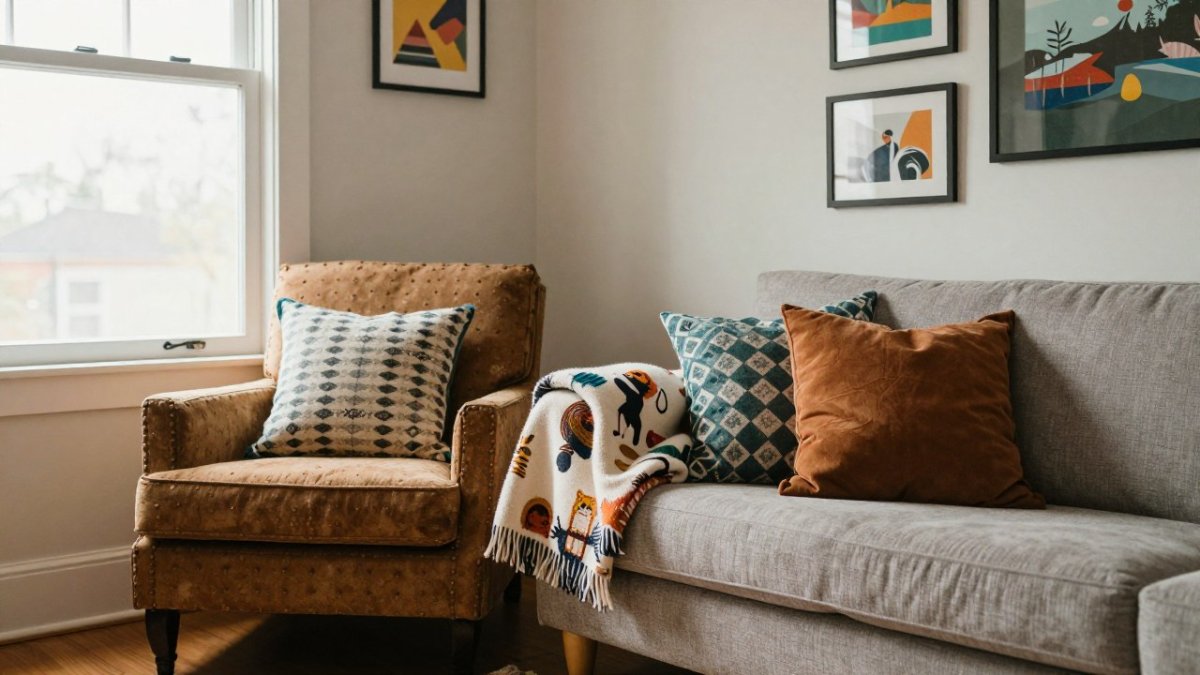
Living Room: The Four-Pass Sequence
Work in four passes, and finish each pass before starting the next.
- Anchor pass. Place the statement piece first, the oversized print, the vintage lamp, the funny printed blanket over the chair back. Stand at the main doorway and confirm it is the first thing your eye lands on. If it is not, move it, not the furniture.
- Seating pass. Float the sofa and chairs around the anchor rather than pushing everything against the walls. Leave comfortable space between the sofa and the coffee table, and keep a clear walkway through the room.
- Textile pass. Add the rug, throws, and pillows. One rule keeps this from going chaotic: the rug should be large enough that at least the front legs of every seat sit on it. A too-small rug is the most common reason a styled living room looks unfinished.
- Accessory pass. Finish with art, lighting, and small finds, and only now. Hang art so the center sits at roughly eye level, and group small objects in odd numbers so they read as one composition rather than scattered dots.
Watch out: if the room feels busy after the accessory pass, remove one item from every surface rather than adding a new one to "balance" it.
Bedroom: Lower the Volume
The bedroom follows the same four passes, but the anchor should be softer, a patterned headboard, a vintage quilt, or a single bold lampshade rather than a floor-standing statement. Keep the palette to two base colors plus one accent, and let the wildcard color live in one small place, such as a pillow or a nightstand tray. Symmetry calms a quirky bedroom: matching nightstands and lamps let an unusual headboard or artwork carry the personality without the room feeling restless.
Entryway: The 30-Second Test
The entryway is where quirky decor earns its keep, because guests see it first and for only a few seconds. Give it one anchor (a console, a bench, or a piece of art), one functional element (a tray or hook for keys), and one conversation piece. Keep the floor clear, a narrow entry needs a clear walkway, and use vertical space for personality so nothing blocks the door swing.
Kitchen: Style Around Function
In the kitchen, quirky decor has to survive heat, grease, and daily use. Put the anchor on an open shelf or the range hood surround, keep counter styling to one tray or one bowl, and choose pieces that can be wiped down. A vintage scale, a colorful ceramic crock, or a framed print above the sink all work because they sit outside the primary work triangle between sink, stove, and refrigerator.
The Repeatable Loop
Once you have run the four passes in one room, the same loop transfers: anchor, seating or primary use, textiles, accessories, then edit. The edit step is the one people skip. Walk out of the room, walk back in, and name the first three things you see. If any is not something you love, move or remove it.
Sourcing Quirky Decor Items on a Budget and in Small Spaces
Budget sourcing is about patience and editing, not spending. Thrifted finds and repurposed pieces give you one-of-a-kind character for less, and small spaces reward a tighter, more curated collection. What most guides skip is what readers actually need: a budget framework, a decision rule for where to spend, and tactics that work when you cannot drill a hole in the wall.
A Simple Budget Framework
Split your decor budget into three buckets before you shop, and hold the split even as the dollar amount changes:
- About half on the anchor. The statement piece is what the room is built around, so it is the one place to spend. A well-made anchor you keep for years beats five cheap ones you rotate out.
- About a third on textiles and lighting. Rugs, throws, pillows, and lamps do more for the feel of a room per dollar than almost anything else, and they are the easiest to change seasonally.
- The remainder on small finds. This is the thrift, estate-sale, and repurposing bucket, the place to be patient and let pieces find you.
A common pattern is to invert this: people spend on small tchotchkes because each one feels inexpensive, then have nothing left for the anchor. Track the running total in a note on your phone so small purchases do not quietly outgrow the anchor budget.
Where to Invest and Where to Save
Invest in pieces that carry weight, get touched daily, or are hard to replace: the anchor, the main rug, a sofa-adjacent throw you will actually use, and lighting you rely on every evening.
Watch out: inspect upholstery seams, drawer joints, and lamp wiring before you buy secondhand. A cheap find that needs rewiring or reupholstering is not a bargain once you price the repair.
Thrifted Finds, Repurposing, and Editing Out the Junky Look
The junky look comes from keeping everything. Editing is the skill that separates a curated room from clutter.
Try this:
- Shop thrift stores and estate sales for unique finds, and go on the first day for selection or the last day for markdowns
- Repurpose old items: a crate as a shelf, a tin as a planter, a ladder as a throw rack
- Keep only pieces that fit your palette
Small-Space and Rental-Friendly Tactics
When you cannot change the walls or the floor plan, put the character where it is reversible:
- Use removable adhesive hooks and strips for art and lightweight shelves, and check the weight rating before hanging anything
- Lean large art against the wall instead of hanging it, it reads as intentional and leaves no holes
- Use a tension rod in a doorway or alcove to hang a textile or curtain and carve out a "room" without construction
For renters, keep a "move-out box" of the pieces you installed with adhesive so you can take them with you and patch nothing. Fewer, better pieces always beat a crowded shelf, and in a small room, the empty space is part of the design.
Split your decor budget into three buckets before you shop, and hold the split even as the dollar amount changes.
| Bucket | Share of budget | What it covers |
|---|---|---|
| Anchor | About half | The statement piece the room is built around |
| Textiles and lighting | About a third | Rugs, throws, pillows, and lamps |
| Small finds | The remainder | Thrift, estate-sale, and repurposing pieces |
Pick Your Anchor Piece and Build the Room Around It
The challenge with quirky decor is knowing when to stop, and a single well-chosen piece can help.
Start with one piece you love, build around it, and let the room tell your story. Browse the funny printed blankets on The Wacky Nutshell's website to find a playful focal point for your space.
Ready to add personality to your space? Browse our collection and find the anchor piece your room has been missing.
Frequently Asked Questions
How do you style quirky home decor without making a room look cluttered?
Give every quirky piece a clear job. Pick one focal point per room, then keep the surrounding surfaces mostly clear so the unusual items stand out instead of competing. Group small collections together on a tray or shelf rather than scattering them, and edit regularly: if a piece no longer earns its spot, move it to another room or store it. Visual balance comes from empty space as much as from the objects themselves.
How do you mix vintage and modern decor without it looking mismatched?
Tie the two eras together with one shared element, such as a repeated color, a common metal finish, or matching wood tones. Pair a single antique statement piece with clean contemporary furnishings rather than splitting the room 50/50. Keep pattern scale varied too: a large geometric rug can sit under a small floral cushion without fighting. The goal is contrast with a thread of consistency running through it.
How can I add whimsy to my living room on a small budget?
Start with what you already own. Rearrange a shelf into a gallery-style display, repurpose a thrifted frame, or add one colorful accent, such as a patterned throw or a humorous printed blanket, to a neutral sofa. Thrift stores and estate sales are reliable sources for one-of-a-kind finds at low cost. Prioritize one or two pieces you genuinely love over a cart full of small items.
How do you choose quirky decor that works with your existing furniture?
Pull one color or finish from your existing furniture and repeat it in the new piece. If your sofa is neutral, a bold quirky item becomes the focal point; if your furniture is already busy, choose a quirkier texture rather than a louder pattern. Check scale before buying: an oversized statement piece needs breathing room, while small accessories suit tight spaces and rentals.